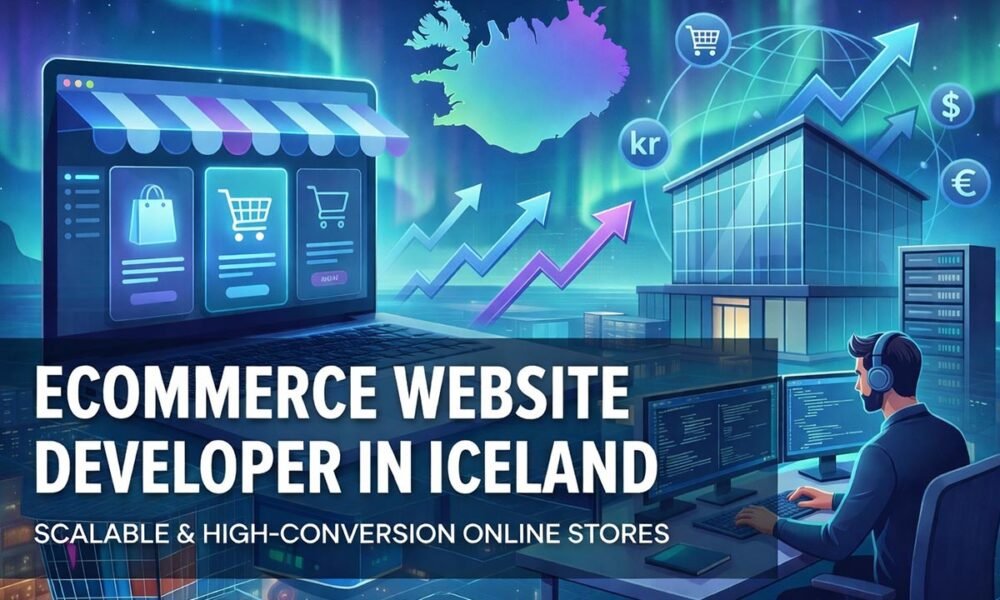
The Definitive 2026 Blueprint: Hiring an Ecommerce Website Developer in Iceland to Build a Global Retail Empire

In the stark and beautiful landscape of Iceland, business has always been about resilience and adaptation. But as we move through 2026, the challenge has shifted. It is no longer enough to have a great product—whether it is sustainable fish leather from the Westfjords, artisanal chocolate from Reykjavík, or high-tech outdoor gear designed for the Highlands. The challenge now is distribution.
For Icelandic businesses, the local market is small, but the global market is limitless. However, the bridge between a local warehouse and a customer in Tokyo, New York, or Berlin is technology. This is where the specific expertise of an E-commerce Website Developer in Iceland becomes the single most critical asset for your company.
We are not talking about someone who simply installs a template. We are talking about a digital architect who understands the unique logistical, financial, and cultural position of Iceland and translates that into a high-performance sales machine. If your website is just a digital brochure, you are leaving millions of Króna on the table. This guide is your roadmap to building a dominant online presence.
Part 1: The Difference Between a “Web Designer” and an “E-commerce Architect”
Many business owners fall into the trap of hiring a generalist web designer. While they may create something visually pleasing, they often lack the engineering mindset required for retail.
The Generalist Approach
A general designer focuses on aesthetics. They care about colors, fonts, and layout. These are important, but they don’t sell products. A generalist might build a site that looks good but crashes when 500 people try to buy a limited-edition sweater at once.
The E-commerce Specialist Approach
A professional e-commerce website Developer thinks like a retailer. They obsess over metrics that directly impact your bank account:
- Latency & Load Time: They know that for every second of delay in page loading, conversion drops by 7%. They optimize code to ensure your high-resolution images of Icelandic nature load instantly, even on 4G networks in rural areas.
- The Checkout Funnel: They view the checkout process as a “leaky bucket.” Their job is to plug the holes. This means removing unnecessary form fields, enabling guest checkouts, and integrating one-click payment solutions like Apple Pay and Google Pay.
- Inventory Logic: They understand that selling a product that is out of stock is a customer service nightmare. They build systems that sync your physical warehouse inventory with your online store in real-time.

Part 2: Why Icelandic E-commerce Requires a Unique Strategy
Iceland is not the UK or the USA. Operating an e-commerce business here comes with a specific set of challenges and advantages that only a specialized developer will understand.
1. The Global Logistics Challenge
Shipping from an island in the North Atlantic is expensive and complex. A generic template won’t handle this. You need a developer who can integrate:
- Dynamic Shipping Calculators: Real-time API connections with Pósturinn, DHL, and FedEx to give customers accurate shipping costs based on weight and destination.
- Custom Duty Logic: If you are selling to the EU or the US, taxes differ. A specialized site can calculate VAT (VSK) removal for exports automatically, making your products 24% cheaper for international buyers and increasing sales.
2. Trust and Authority
When an international customer lands on an Icelandic site, they might hesitate. “Is this legitimate? Will my package arrive?” Your developer builds trust through “Digital Body Language”:
- Displaying verified payment badges (Borgun/Salt/Valitor).
- Showcasing live reviews via Trustpilot or Yotpo integrations.
- Implementing SSL encryption that is visible to the user.
3. Multilingual Capabilities (The Language Barrier)
Your site needs to speak the language of your customer. This goes beyond Google Translate. A developer sets up Hreflang tags so that a user in Germany sees the German version of your site automatically, while a user in the US sees English. This is crucial for SEO and user experience.
Part 3: Deep Dive into Core Technical Features (The 2026 Standard)
To dominate the market in 2026, your e-commerce platform needs to be built on a foundation of cutting-edge technology. Here are the non-negotiables.
Mobile-First and “Thumb-Friendly” Design
We have moved past “mobile-responsive.” We are now in the era of Mobile-First. This means the site is designed for the smartphone screen before the desktop.
- The Thumb Zone: Key buttons like “Add to Cart” and “Checkout” are placed within easy reach of the user’s thumb.
- Simplified Navigation: Hamburger menus and sticky footers that make browsing effortless on small screens.
- Speed: Utilizing AMP (Accelerated Mobile Pages) technology or PWA (Progressive Web Apps) to make the site feel like a native app.
Headless Commerce Architecture
For brands expecting high growth, “Headless Commerce” is the future. This separates the front-end (what the user sees) from the back-end (the database).
Why it matters: It allows you to change your site’s design instantly without risking the security of your payment data. It also allows you to sell on smartwatches, voice assistants, and social media feeds using the same central engine.
Advanced Search Functionality
If a user can’t find it, they can’t buy it. A professional developer implements Elasticsearch or Algolia. These tools handle typos (e.g., searching for “wul” instead of “wool”) and offer predictive results, showing the user the product before they finish typing.
Part 4: The Platform Battle – Shopify vs. WooCommerce vs. Custom
One of the first questions your E-commerce Website Developer in Iceland should help you answer is: “Where do we build this?”
1. Shopify (The Scalable Giant)
Best For: Brands that want to launch quickly and scale globally without worrying about servers.
- Pros: Incredible security, thousands of apps, and excellent multi-currency support.
- Cons: Transaction fees and less design flexibility unless you pay for Shopify Plus.
Iceland Context: Works perfectly with Icelandic payment gateways and is the standard for export-heavy businesses.
2. WooCommerce (The Content King)
Best For: Brands that have a strong story to tell (blogs, videos) alongside their products.
- Pros: You own the data. It is built on WordPress, so it is infinitely customizable for SEO.
- Cons: You are responsible for security updates and hosting speed. If your developer leaves, it can be hard to manage.
Iceland Context: Great for smaller boutiques or tourism-linked shops that need deep content integration.
3. Custom / Magento / BigCommerce
Best For: Enterprise-level B2B companies or wholesalers.
- Pros: Can handle complex pricing tiers (e.g., wholesale vs. retail) and massive inventories of 50,000+ SKUs.
- Cons: Expensive to build and maintain.

Part 5: Ecommerce SEO – The Art of Being Found
Building the site is only step one. Step two is ensuring customers find you when they search for “Icelandic sweater” or “Buy Omnom Chocolate.”
Technical SEO for E-commerce
Your developer creates a roadmap for Google’s bots:
- Schema Markup: Code that tells Google “This is a product, it costs 5000 ISK, and it is in stock.” This allows your products to appear in the “Shopping” tab of Google results.
- Canonical Tags: Preventing Google from getting confused by duplicate pages (e.g., a shirt in Blue vs. Red).
- Sitemap Submission: Automatically updating Google whenever you add a new product.
Site Architecture
A flat site structure ensures that no product is more than 3 clicks away from the homepage. This passes “link juice” (authority) from your main page to your products, helping them rank higher.
Part 6: The Development Lifecycle – What to Expect
When you hire a professional e-commerce website Developer in Iceland, the process should be structured and transparent.
- Phase 1: Discovery & Strategy We don’t write a line of code until we understand your business. Who is your customer? What are your margins? Who are your competitors?
- Phase 2: UX/UI Wireframing. We build a blueprint. This is a black-and-white version of your site to test the flow. We ask: “Is the checkout smooth? Is the search bar visible?”
- Phase 3: Development & Integration This is where the magic happens. We code the custom theme, integrate the payment gateways (Salt, Dalpay), and set up the shipping APIs.
- Phase 4: Stress Testing. We simulate high traffic. What happens if 10,000 people visit during a massive sale? We ensure the site stays fast and stable.
- Phase 5: Launch & Training We launch the site, but we also train your team. You need to know how to add products, process refunds, and read analytics without calling a developer every time.
Part 7: Future-Proofing – Trends for 2026 and Beyond
The digital world changes fast. A great developer builds for tomorrow, not just today.
AI-Driven Personalization
Imagine a website that remembers a customer’s size or color preference. In 2026, AI tools can dynamically change the homepage to show products relevant to that specific user, increasing conversion rates by up to 15%.
Sustainability Transparency
Icelandic brands are known for nature. Your site should reflect this. Developers can integrate “Carbon Footprint Calculators” at checkout, enabling customers to offset the carbon emissions associated with their shipping. This resonates deeply with modern, eco-conscious consumers.
Voice Search Optimization
With the rise of smart speakers, people are asking, “Alexa, buy me organic face cream from Iceland.” Your product descriptions need to be optimized for natural language search to capture this market.
Conclusion: Your Digital Flagship Store
Ultimately, your e-commerce website is more than just code. It is your flagship store and is open 24 hours a day, 365 days a year. It speaks every language and serves every country.
Investing in a specialized e-commerce website Developer in Iceland is not an expense; it is the most significant investment you can make in the future of your brand. In a world where the competition is only a click away, you cannot afford to be second best. You need a platform that is robust, beautiful, and relentlessly focused on one thing: Growth.
Don’t let your business stay local when your potential is global. Build the digital infrastructure that your brand deserves.
You can contact us on FaceBook (@rajtechblog), Twitter (@rajtechblog), or DM us on Instagram (@rajtechblog). We will feature your free apps in this section!
Read this “Tourist Website Developer in Iceland | Tourism Website Design”