List of Data Centers in Iceland: Where the Future of AI and Green Technology is Taking Shape

The global technology landscape is undergoing a massive transformation, driven almost entirely by the insatiable computing demands of Artificial Intelligence (AI), Machine Learning (ML), and High-Performance Computing (HPC). Training massive Large Language Models (LLMs) and rendering complex data simulations require more than just cutting-edge software; they require physical hardware operating at an unprecedented scale.
However, there is a hidden crisis in this technological boom: power consumption. Modern servers generate extreme amounts of heat and consume gigawatts of electricity. As energy prices skyrocket across traditional tech hubs in North America and mainland Europe, and as corporate pressure to reduce carbon footprints intensifies, tech giants are quietly migrating their digital infrastructure.
They are moving to a location defined by volcanic activity, glaciers, and a seemingly endless supply of cheap, green electricity: Iceland.
Over the last decade, Iceland has evolved from a remote island nation into one of the most critical digital infrastructure hubs on the planet. Its unique geographical features—a naturally freezing climate and a power grid running on 100% renewable energy—make it the ultimate playground for power-hungry enterprise computing.
Whether you are a cloud service provider scaling your operations, an AI startup looking to train models without burning through your venture capital on electricity bills, or an IT director researching global facilities, this comprehensive guide will break down everything you need to know. We will explore the major data centers operating in Iceland, the underlying technology that powers them, and why the global data center industry is pivoting towards the Nordics.
The Global Computing Crisis and the Icelandic Solution
Before diving into the specific facilities, it is crucial to understand exactly why companies are leaving established hubs like Frankfurt, London, Amsterdam, and Paris (the FLAP markets) to build infrastructure in the North Atlantic. The answer comes down to rack density and cooling physics.
A decade ago, a standard server rack in a data center consumed about 3 to 5 kilowatts (kW) of power. Today, a single server rack packed with NVIDIA H100 GPUs designed for AI training can consume anywhere from 40kW to 80kW.
When you put that much electrical power into a confined space, nearly all of it is converted into extreme heat. In a traditional data center located in Texas or Germany, massive mechanical chillers and air conditioning units must run 24/7 just to keep the servers from melting. Sometimes, the cooling systems use as much electricity as the servers themselves.
Iceland solves this physics problem naturally.
The Geothermal and Hydroelectric Advantage
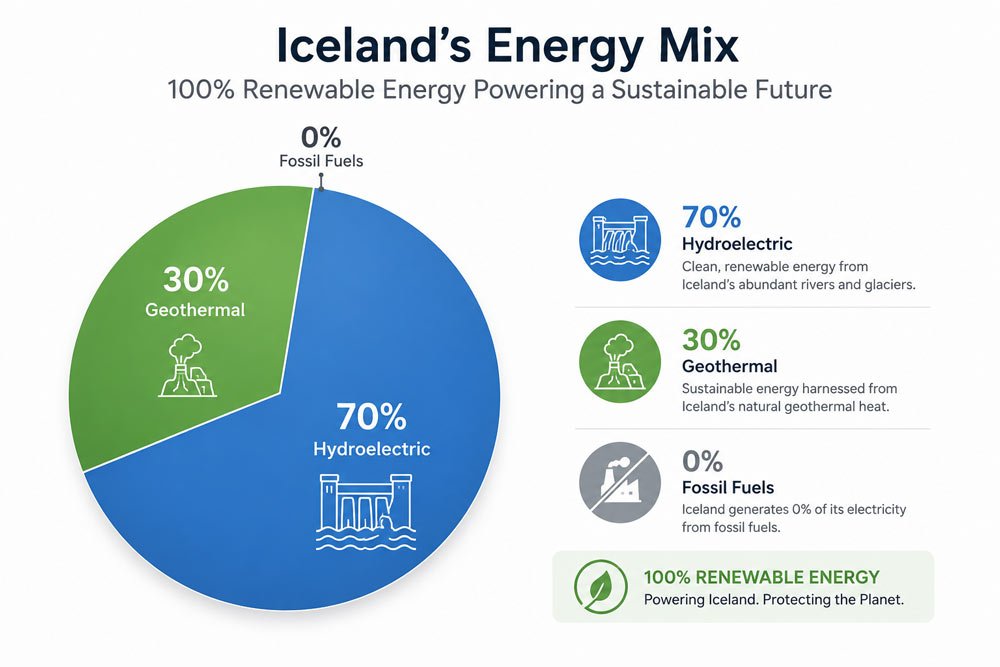
Iceland’s energy grid is an engineering marvel. It is one of the only countries in the world that generates 100% of its electricity from renewable sources. Approximately 70% comes from hydroelectric power (harnessing the flow of glacial rivers), and 30% comes from geothermal energy (tapping into the earth’s natural volcanic heat).
Because the nation isn’t relying on imported coal, oil, or natural gas, the cost of electricity is remarkably stable and incredibly cheap compared to European averages. For a company running a 10-megawatt computing cluster, shifting operations to Iceland can result in millions of dollars in power savings every single year.
The Mechanics of “Free Natural Cooling”
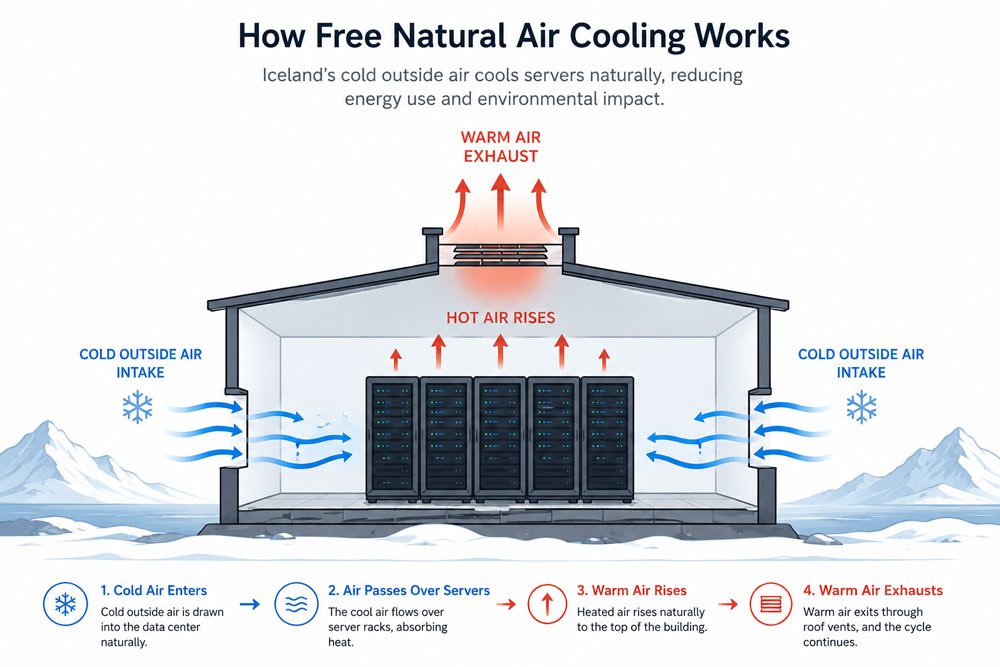
In the data center industry, there is a metric called PUE (Power Usage Effectiveness). A PUE of 2.0 means that for every watt of power used for computing, another watt is used for cooling and lighting (which is highly inefficient).
Because Iceland’s average year-round temperature hovers around 5°C (41°F), data centers here rarely need mechanical chillers. Instead, they use “air-side economizers.” This is a sophisticated way of saying they open the vents, filter the cold outside air, and push it directly across the hot servers. The hot air is then exhausted out of the building. This natural process drops the PUE of Icelandic data centers down to 1.05 to 1.1—making them some of the most energy-efficient buildings ever constructed.
An In-Depth Look at the Major Data Centers in Iceland
The data center ecosystem in Iceland is dominated by a few major players who have heavily invested in transforming the rocky landscape into high-tech server farms. Here is a detailed breakdown of the leading facilities.
1. Verne Global
Location: Keflavík, Reykjanes Peninsula
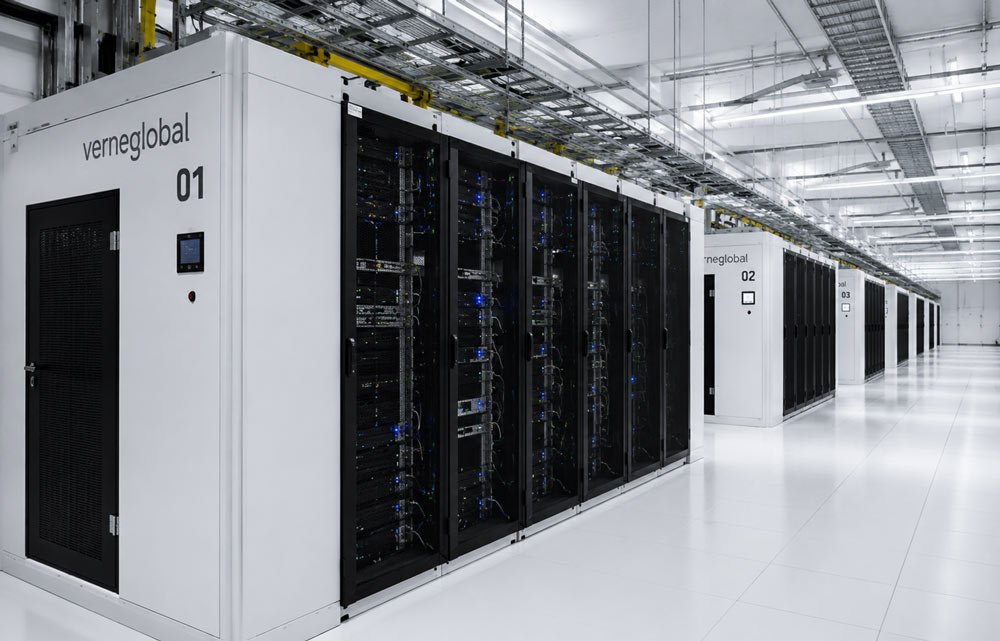
If you are discussing Icelandic data centers in corporate boardrooms, Verne Global is usually the first name mentioned. Located on a 40-acre campus that was originally a massive NATO airbase, Verne Global has repurposed robust military infrastructure into one of the most advanced computing campuses in the world.
Core Focus: High-Performance Computing (HPC) and AI
Verne Global doesn’t just cater to standard website hosting; it is engineered for heavy, intense workloads. Early on, automotive giants like BMW moved their crash-test simulation computing to Verne Global. Today, the facility is dominated by financial institutions running complex algorithmic trading models, genomics companies analyzing DNA sequences, and AI developers training generative models.
Infrastructure and Engineering
The facility is highly modular, meaning they can custom-build halls to specific client requirements. Because AI racks are so incredibly dense, Verne Global has optimized its infrastructure to support both direct-to-chip liquid cooling (where coolant is pumped directly over the processors) and high-velocity air cooling. By tapping into the local geothermal grid, they offer long-term fixed-price power contracts, which is a massive financial advantage for companies tired of fluctuating global energy markets.
2. atNorth
Locations: Reykjavík (ICE01, ICE02) and expanding across the Nordics
atNorth (formerly known as Advania Data Centers before a strategic rebranding and expansion) has positioned itself as the premier partner for ultra-high-density computing and enterprise colocation. They operate multiple sites in Iceland and have rapidly expanded into Sweden and Finland, creating a pan-Nordic infrastructure web.
Core Focus: High-Density AI Workloads and Heat Recovery
atNorth stands out for its aggressive adoption of cutting-edge cooling technologies. While they utilize Iceland’s free air cooling, they are also pioneers in heat recovery. In some of their Nordic facilities, the massive amount of heat generated by the servers isn’t just thrown outside; it is captured and pumped into local district heating systems to warm nearby homes. This creates a circular energy economy that appeals heavily to ESG (Environmental, Social, and Governance) focused corporations.
Why Enterprises Choose atNorth
For an IT director, atNorth provides immense scalability. A company can start with a few racks for colocation and seamlessly scale up to dedicated halls for massive GPU clusters. They offer heavily managed environments, meaning they don’t just provide the floor space and power; their on-site engineering teams actively help enterprises manage hardware deployments, optimize network routing, and maintain ultra-low latency connections.
3. Borealis Data Center
Locations: Blönduós (North Iceland) and Reykjanesbær (Southwest Iceland)
While many data centers cluster near the capital city of Reykjavík, Borealis Data Center made a strategic decision to build its flagship facility in Blönduós, in the northern part of the country.
Core Focus: Uncompromising Sustainability and Security
Borealis is designed for companies that prioritize long-term stability and maximum energy efficiency. By situating themselves further north, they experience even cooler ambient temperatures, pushing their cooling efficiency to the absolute physical limits.
The Blönduós campus is built right next to the Blanda hydroelectric power station. This physical proximity to the power generation source means there is virtually zero transmission loss. Electricity goes straight from the glacial river into the servers. Borealis is highly favored by global enterprises looking for secure, remote disaster recovery sites. If a primary data center in Europe experiences a catastrophic failure, the data backed up at Borealis remains completely insulated and secure.
4. Advania (IT & Cloud Services)
Location: Reykjavík
It is important to distinguish between atNorth (which spun off to handle physical data center infrastructure) and Advania, which remains one of Iceland’s largest and most comprehensive IT service providers.
Core Focus: Managed Cloud, Cyber Security, and Enterprise Solutions
While you might not go to Advania just to rent physical floor space for massive hardware, you go to them for complete digital infrastructure solutions. They provide the software and management layer that sits on top of the physical data centers.
Advania is deeply integrated into the Icelandic public and private sectors, managing data for government agencies, the healthcare system, and major financial institutions. They offer robust private cloud deployments, secure enterprise storage, and highly sophisticated cybersecurity monitoring. If a mid-sized European enterprise wants to migrate their entire IT backend to a green, secure environment without having to buy their own servers, Advania provides the fully managed “infrastructure-as-a-service” (IaaS) solution.
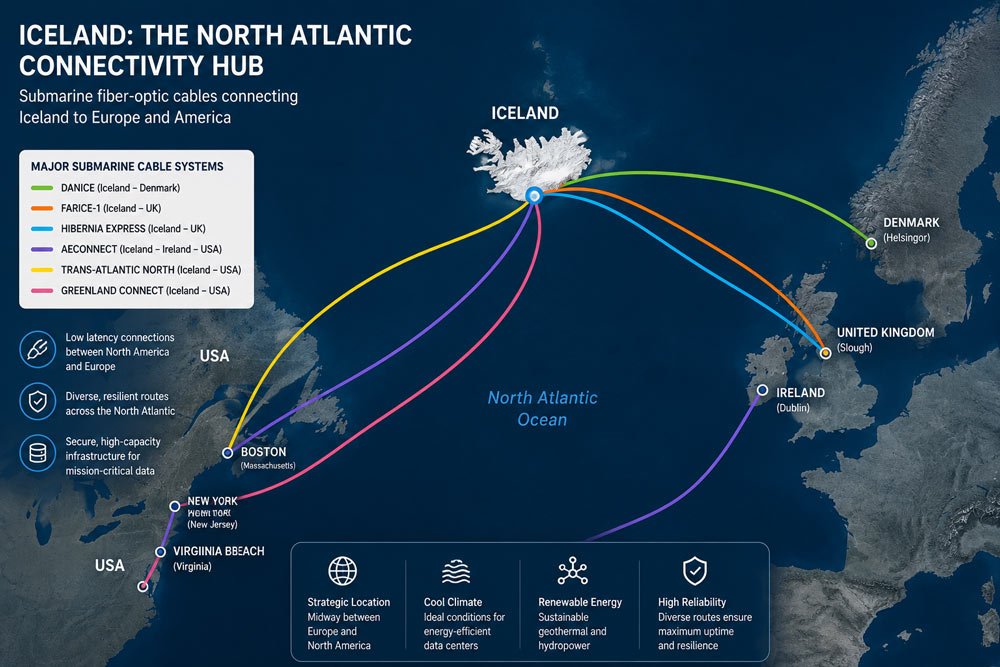
The Backbone of Connectivity: Submarine Fiber-Optic Cables
A common misconception is that because Iceland is an island in the North Atlantic, it must suffer from slow internet speeds. In the world of enterprise computing, processing power is useless if the data cannot be transmitted back to users quickly.
Iceland has solved the isolation problem by heavily investing in an extensive network of subsea fiber-optic cables. This network provides massive bandwidth and surprisingly low latency (the time it takes for data to travel from point A to point B).
Currently, Iceland is connected to the world via several major submarine cable systems:
- FARICE-1: Connecting Iceland to Scotland (UK).
- DANICE: Providing a direct, high-capacity link to Denmark, connecting Iceland straight into the heart of mainland Europe’s internet backbone.
- IRIS: The newest addition, connecting Iceland to Galway, Ireland. This cable is crucial because Ireland is home to massive data center campuses for Google, Meta, and AWS, allowing for seamless data transfer between these major hubs.
- Greenland Connect: Linking Iceland westward to Greenland and onwards to Canada and the United States.
What Does This Mean for Latency?
Thanks to these cables, the latency between Iceland and London is roughly 15 to 19 milliseconds. To put that in perspective, the blink of a human eye takes about 100 milliseconds. While Iceland might not be the ideal location for High-Frequency Trading (where microseconds dictate financial fortunes in Wall Street or the City of London), it is more than fast enough for cloud computing, video rendering, AI model training, SaaS application hosting, and big data processing.
Security, Compliance, and Data Sovereignty
When enterprise organizations move their data across international borders, regulatory compliance becomes just as important as cooling costs. Iceland offers a remarkably stable and secure legal environment for data hosting.
The GDPR Advantage and the EEA
Although Iceland is not a member of the European Union (EU), it is a vital member of the European Economic Area (EEA). This distinction is incredibly important for data centers. It means that Iceland fully complies with the General Data Protection Regulation (GDPR)—the strict European law governing data privacy.
When European companies host their data in Iceland, they face zero legal friction regarding cross-border data transfers. The data is treated exactly as if it were hosted in Germany or France, ensuring full regulatory compliance without the exorbitant operational costs of mainland Europe.
Physical and Geopolitical Security
Iceland is frequently ranked as one of the safest and most politically stable countries on Earth. It has a low crime rate, a stable democratic government, and no standing army. For a company hosting mission-critical intellectual property, this geopolitical neutrality is a massive asset.
Furthermore, the data centers themselves are heavily fortified. Beyond standard CCTV and 24/7 on-site security personnel, facilities employ “man-trap” entry vestibules, strict biometric access (including retina and fingerprint scanners), and deep physical separation between different clients’ server cages to ensure total hardware isolation.
The ESG Mandate: Why Green Hosting is No Longer Optional
For a long time, moving to an Icelandic data center was simply a cost-saving measure. Today, it is a corporate necessity driven by ESG (Environmental, Social, and Governance) mandates.
Major corporations are facing immense pressure from governments, shareholders, and consumers to reduce their carbon footprints. A significant portion of a tech company’s carbon footprint falls under “Scope 3 emissions”—which includes the indirect emissions generated by their supply chain and outsourced IT infrastructure.
If a company hosts its servers in a data center powered by a coal grid, those carbon emissions are added to their corporate ledger. By migrating their workloads to Iceland’s 100% renewable grid, a company can virtually eliminate the carbon footprint of their digital infrastructure overnight. This allows global enterprises to hit their ambitious ‘Net Zero’ climate targets years ahead of schedule, providing a massive boost to their brand reputation and investor relations.
Frequently Asked Questions (FAQs)
1. Is Iceland’s volcanic activity a risk to data centers?
While Iceland is famous for its volcanoes, data center campuses are strategically located in zones with extremely low geological risk. Furthermore, facilities are built with advanced seismic isolation engineering to withstand tremors. The benefits of the geothermal energy produced by this activity far outweigh the localized risks, which are heavily mitigated by careful site selection.
2. Can small-to-medium businesses (SMBs) benefit from Icelandic data centers?
Absolutely. While we often discuss massive enterprise AI clusters, companies like Advania and atNorth offer standard cloud hosting, virtual private servers (VPS), and basic colocation services. An SMB can easily rent a fraction of a rack or buy managed cloud services to benefit from Iceland’s green energy and high security without needing a massive budget.
3. What is Direct Liquid Cooling (DLC), and why is it happening in Iceland?
As AI chips (like NVIDIA’s architecture) get hotter, blowing cold air on them is no longer enough. Direct Liquid Cooling involves running specialized, non-conductive fluid directly over the processors to absorb heat. Icelandic data centers are heavily retrofitting their infrastructure to support DLC, combining it with their naturally cool climate to handle the highest-density server racks in the world.
4. How does the cost of hosting in Iceland compare to the USA or mainland Europe?
While the upfront cost of shipping physical hardware to Iceland can be an initial hurdle, the long-term operational costs (OpEx) are significantly lower. The combination of cheap, fixed-rate renewable power and near-zero cooling costs means the Total Cost of Ownership (TCO) over a 3-to-5-year hardware lifecycle is drastically cheaper than hosting in Frankfurt, London, or Virginia.
5. What is the future of the Icelandic data center industry?
The future is deeply intertwined with Artificial Intelligence. As the world moves towards Generative AI and AGI research, the demand for high-performance computing will only multiply. Expect to see massive expansions of existing campuses, more submarine cables laid to increase global bandwidth, and Iceland cementing its position not just as a storage hub, but as the primary “engine room” for global AI development.
Conclusion
The narrative around data centers has fundamentally shifted. They are no longer just passive digital warehouses where companies store old email archives and website files. They are the active factories of the modern economy, churning through massive datasets, training the AI models that will define the next decade, and powering the global cloud.
As this computing revolution demands more power, the industry cannot continue to rely on unsustainable, carbon-heavy energy grids. Iceland has provided the perfect alternative. By marrying a naturally freezing climate with an abundance of 100% renewable geothermal and hydroelectric energy, Iceland has created an environment where high-performance computing can thrive without destroying the environment or corporate budgets.
For companies looking to the future—whether you are a hyperscale cloud provider or an enterprise IT architect—the data centers of Iceland, including Verne Global, atNorth, and Borealis, offer the ultimate combination of raw power, uncompromising security, and true environmental sustainability. In the race to build the digital future, Iceland is already leading the way.
Other Articles